AS Social Media Trends #nmsm
This document is a subsection of New Media and Social Movements > Arab SpringSee also:
The Arab Spring: Social Media Trends
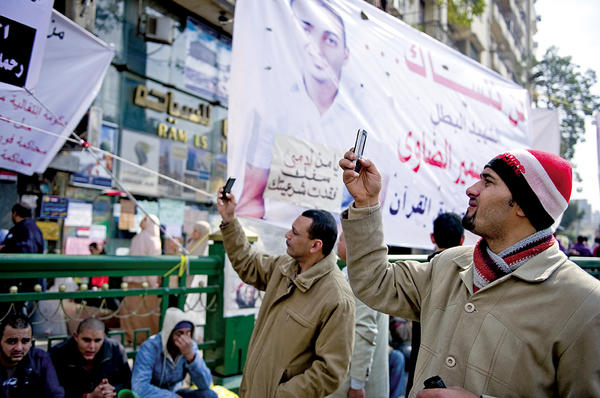 Twitter and Facebook have played a crucial role in providing Arab citizens with a space to pressure regimes to democratize power and increase transparency. The impact of social media in the Arab Spring is undeniable.
According to research conducted by DSG’s Governance and Innovation program, the penetration of social networking and Web 2.0 technologies is soaring in the Arab region. Demographically, the Arab region is a youthful one, where youth between the ages of 15 and 29 make up around one-third of the population. With the exponential growth of online social networking—particularly among this demographic, who will in the next few years become active citizens, potential entrepreneurs and part of the government and private sector workforce—it is argued that social networking tools have the potential to enhance citizen engagement in the region, promote social inclusion and create opportunities for employment, entrepreneurship and development.
The civil movements in Tunisia and Egypt during December 2010 and January 2011 are a prime example of the growth and shift in social media usage by citizens. The proportion of Tunisian citizens connected through Facebook, for example, (Facebook penetration) increased by 8% during the first two weeks of January 2011. The type of usage also changed markedly, shifting from being merely social in nature to becoming primarily political.
During the Arab Spring, new social media in the form of Youtube, Twitter, Facebook, blogs, and SMS communication in many instances were able to bypass state controlled national media and circulate images and reports of mass defiance through the Middle East and North Africa.1
Some key examples of new media and communications impacting the Arab Spring are:
- 65% of the population in the Middle East is under the age of 30 and are increasingly savvy with new forms of communication 2
- Bloggers in Egypt and Tunisia were instrumental in publicizing accounts of torture and human rights vioaltions by security services 2
- New social media allows for different forms of political conversation and engagement, as well as social inclusion and participation 3
- Each Arab uprising, trackable on Twitter with a unique hashtag, had regular updates of information and links to crowd-sourcing maps 4
- Citizen engagement on the internet in the Arab world is expected to grow to over 100 million Arab users by 2015 4
- NATO used social and online media incombination with other sources to help determine targets for air-strikes in Libya and to assess their success 5
- During the uprising there were several instances of regimes shutting down the internet in an attempt to stop the stream of information and images leaving protests 6
Some forms in which social networks contributed to the uprisings (What Twitter and Facebook meant in the Egyptian Revolution):
- Created rallying points -- sparks burst into flames of outrage.
- Enabled people to see how many others shared their perspective.
- Enabled people to coordinate activities and get the word out about protests.
- Allowed memes about revolution to spread.
Facebook in the Arab World: a snapshot
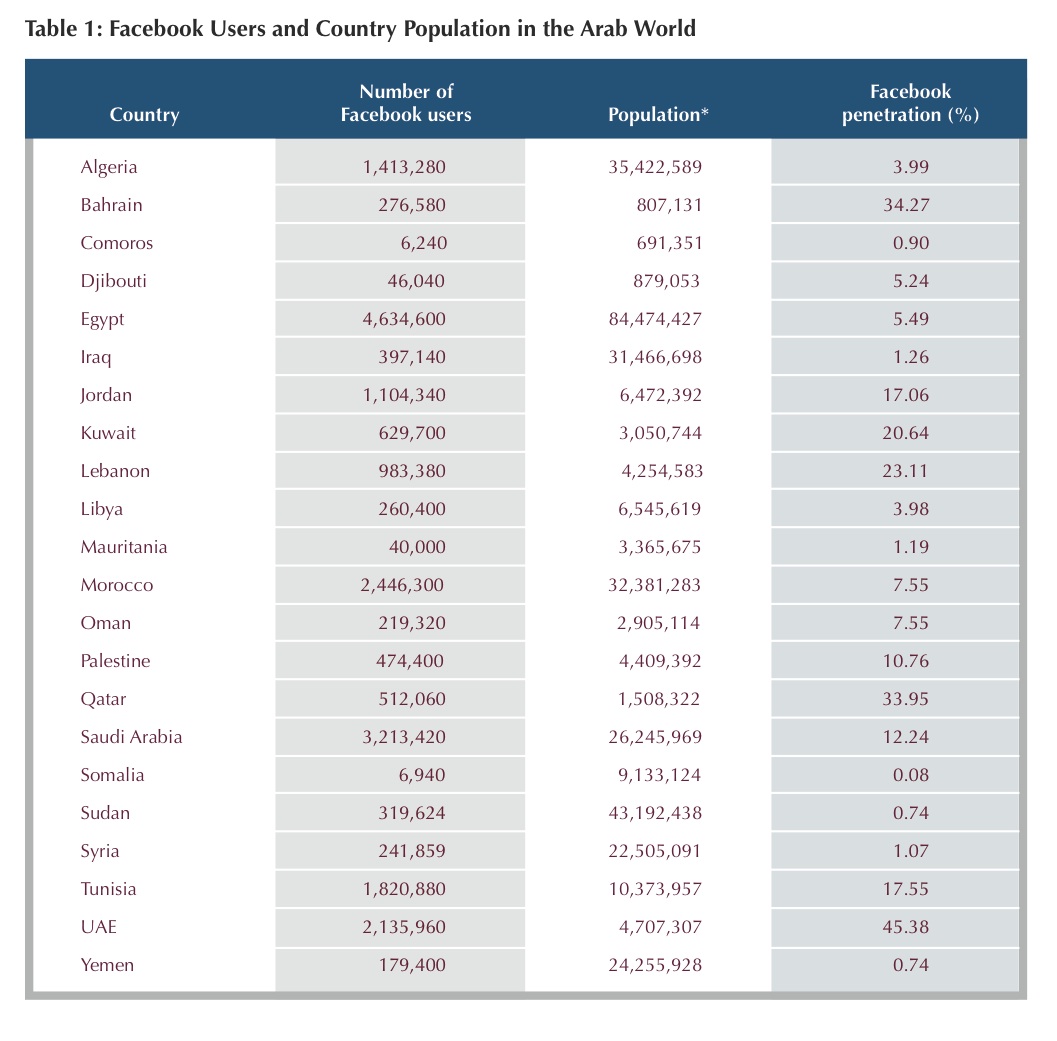
- The total number of Facebook users in the Arab world stands at 21,361,863 (Dec. 2010), up from 11,978,300 (Jan. 2010), a 78% annual growth rate.
- At the end of 2010, the country average for Facebook user penetration in the Arab region was 5.94%.
- The UAE has the highest penetration rate in the Arab region, with more than 45% of the population having Facebook accounts.
- GCC countries dominate the top five Arab FB users as percentage of population, with Lebanon being the only exception.
- With around 4.7 million Facebook users, Egypt constitutes about 22% of total users in the Arab region.
- Youth (between the ages of 15 and 29) make up 75% of Facebook users in the Arab region.
- Gender breakdown of Facebook users indicates an average 2:1 ratio of male to female users in the Arab region, compared to almost 1:1 globally.
Crowdmapping
Similar to Twitter and Facebook, crowdmaps rely on user-generated videos, images, and reports; the difference is that information is verified and geo-plotted on online maps, usually by nonprofits or a trusted network of local citizens.
Voice Of America Middle East recently launched a crowdmap project of its own to allow citizens in Arab countries to submit information and footage directly to the website. Known as Behind the Wall, this project calls for citizens in Syria, Yemen and Bahrain to report and submit videos straight from the streets. But the effect of these websites remains to be seen. (More on Crowdmapping Arab Spring - Next Social Media Breakthrough?)
References and Resources
1 Cottle, S., ‘Media and the Arab Spring uprisings of 2011: Research Notes’, Journalism, SAGE, Cardiff University UK, (2011)
2 Ulrichsen, K., Held, D., Brahimi, A., ‘The Arab 1989?’, Open Democracy (2011)
3 Dahlgren, P., ‘Media and Political Engagement: Citizens Communication and Democracy’, Cambridge University Press (2009)
4 Ghannam, J., ‘Social Media in the Arab World: Leading up to the Uprisings of 2011’, Washington, DC: Center for International Media Assistance (2011)
5 "Anti-Gaddafi forces add Twitter to armoury", Tim Bradshaw and James Blitz, Financial Times (London), 15 June 2011
6 Libya Profile, BBC News, 31 August 2011